Long before dawn, on a road that runs straight into the dark of the Campeche jungle, you begin to understand that this will not be like other ruins. There is no town at the gate, no row of souvenir stalls, no crowd. There is a sixty-kilometer single-track road, the cries of howler monkeys carrying through the canopy, and, if you are early and quiet, the possibility of a jaguar's print pressed into the mud. At the end of it stands Calakmul: the lost capital of the most powerful dynasty the Maya ever knew, swallowed by the largest tropical forest in Mexico, and one of the few places on earth recognized by UNESCO for both its culture and its nature.
Of everything within reach of Campeche, Calakmul asks the most of you. It gives the most in return.
The Snake Kingdom
For most of the Classic period, the Maya world turned on a rivalry between two superpowers. One was Tikal, in the Petén of present-day Guatemala. The other was Calakmul, seat of the Kaan, or Snake, dynasty, whose rulers stamped a serpent's head as their emblem and, for a time, built the widest network of alliances and vassal states in the entire Maya lowlands.
This was not a provincial city. At its height Calakmul commanded a sphere of influence stretching across hundreds of kilometers, and its kings waged a generations-long contest with Tikal that shaped the politics of the whole region. More than a hundred carved stelae once stood among its plazas, the densest concentration of monumental inscriptions of any Maya city, recording accessions, victories and the names of the Snake lords. To walk Calakmul is to walk the capital of an empire that history nearly forgot.
Architecture you feel in your knees
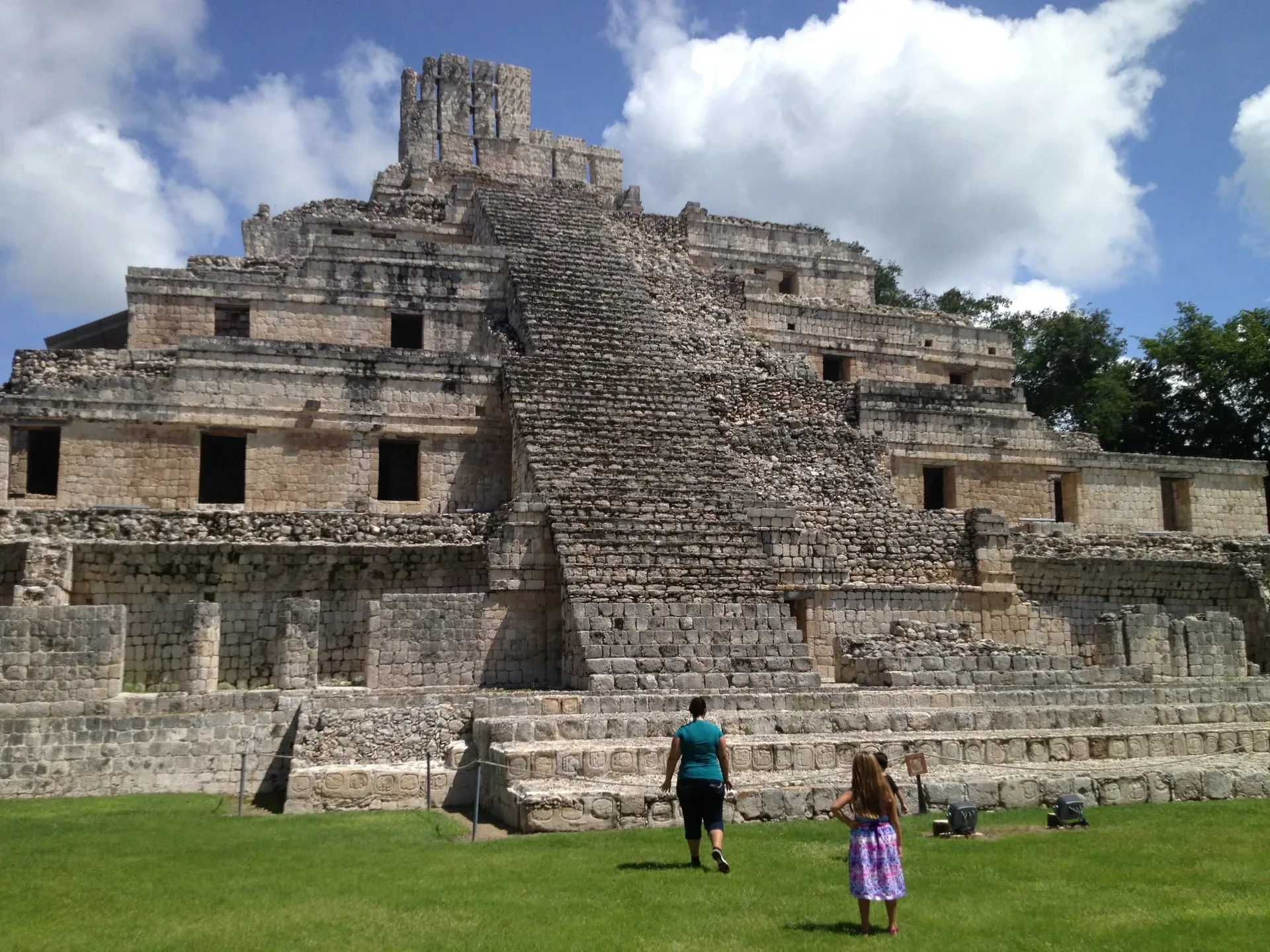
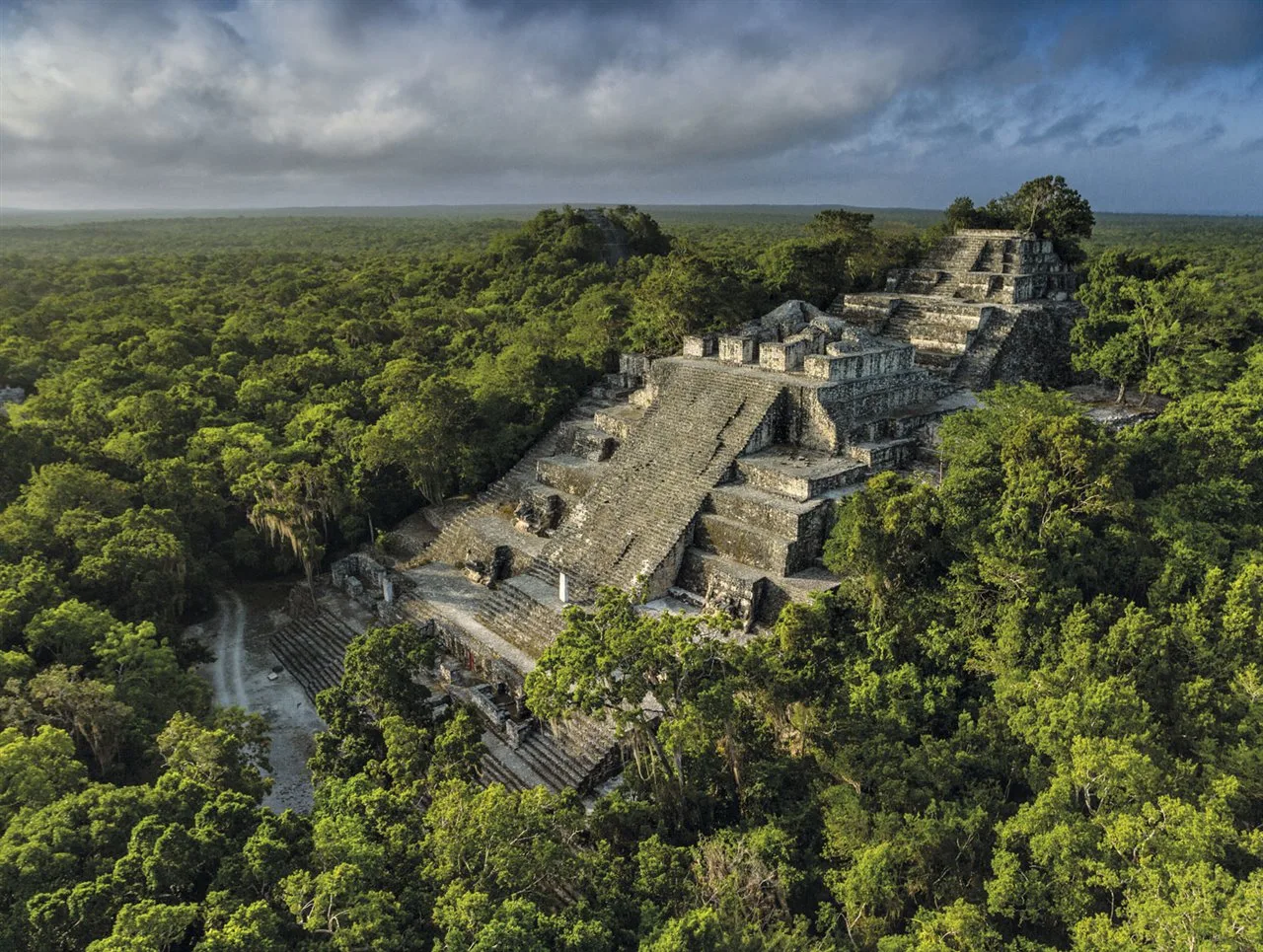
Calakmul is the supreme example of the Petén style, Maya architecture at its most massive and vertical. Its Structure II is among the largest pyramids the Maya ever raised, a mountain of cut stone built up over centuries, with earlier temples sealed inside later ones like the rings of a tree. The climb is real and the reward is total: from the summit, the forest spreads to every horizon, unbroken, with the crests of distant temples breaking the green canopy like islands. There is no modern building in sight, no road, no sound but birds. It is one of the few places where you can stand inside an ancient city and see almost exactly what its kings saw a thousand years ago. (Calakmul is the Petén chapter of the four Maya architectural styles around Campeche.)
Down at ground level, Calakmul holds a quieter marvel: the painted murals of the Chiik Nahb acropolis, rare among Maya art for depicting not gods and kings but ordinary people, market vendors, a woman serving maize gruel, a man carrying salt. They are among the very few surviving images of everyday Maya life, and they make the dynasty suddenly, movingly human.
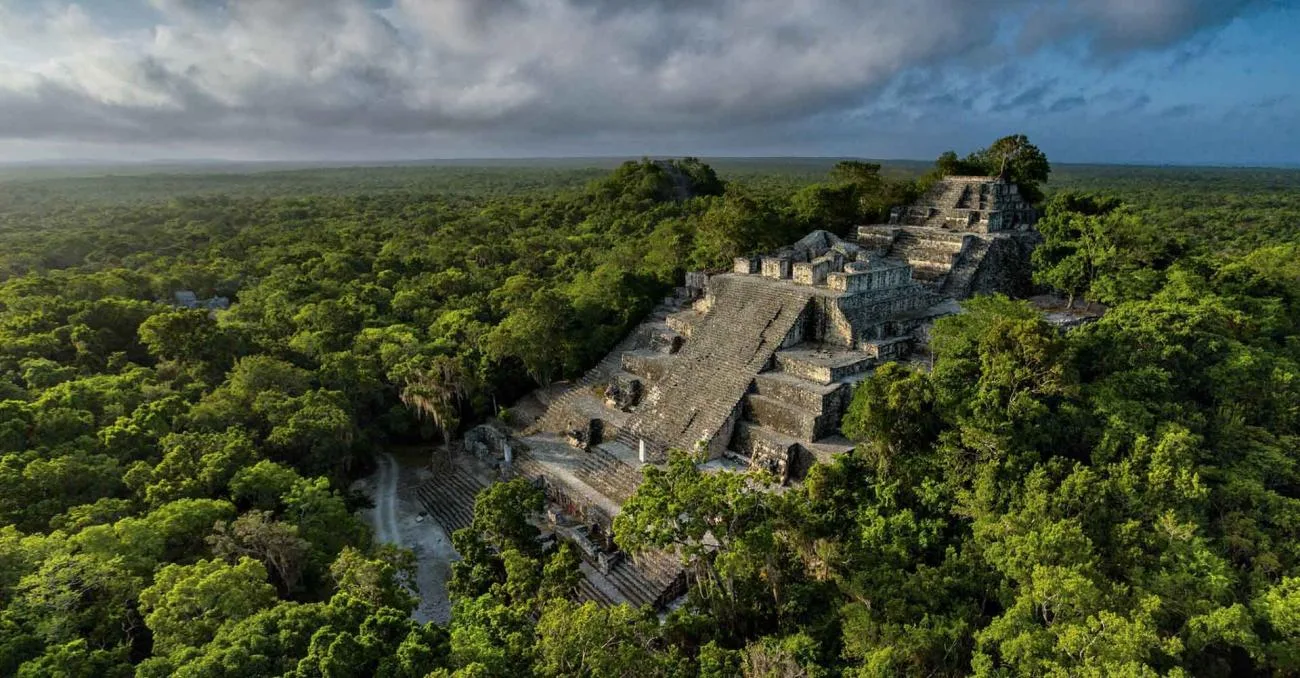
The Calakmul Biosphere Reserve, the largest tropical forest in Mexico, a Mixed World Heritage site.
A forest, not just a ruin
Here is what sets Calakmul apart from every other Maya site in Mexico: it is protected as a Mixed World Heritage property, listed by UNESCO for its archaeology and for the living forest that surrounds it. It was first recognized as a cultural site in 2002 and extended to a mixed site in 2014, as the "Ancient Maya City and Protected Tropical Forests of Calakmul". The Calakmul Biosphere Reserve safeguards one of the largest continuous expanses of tropical forest in the Americas, second in scale on the continent only to the Amazon.
That forest is fully inhabited. It shelters the highest density of jaguars in Mexico, along with puma, ocelot and the elusive tapir; spider and howler monkeys move overhead; the ocellated turkey, iridescent, almost prehistoric, picks across the plazas at first light. Hundreds of bird species pass through. Visiting Calakmul is therefore two journeys at once: into deep human history and into one of the last great wildernesses of Mesoamerica. (For more of Campeche's protected nature, see Los Petenes & Xpicob.)
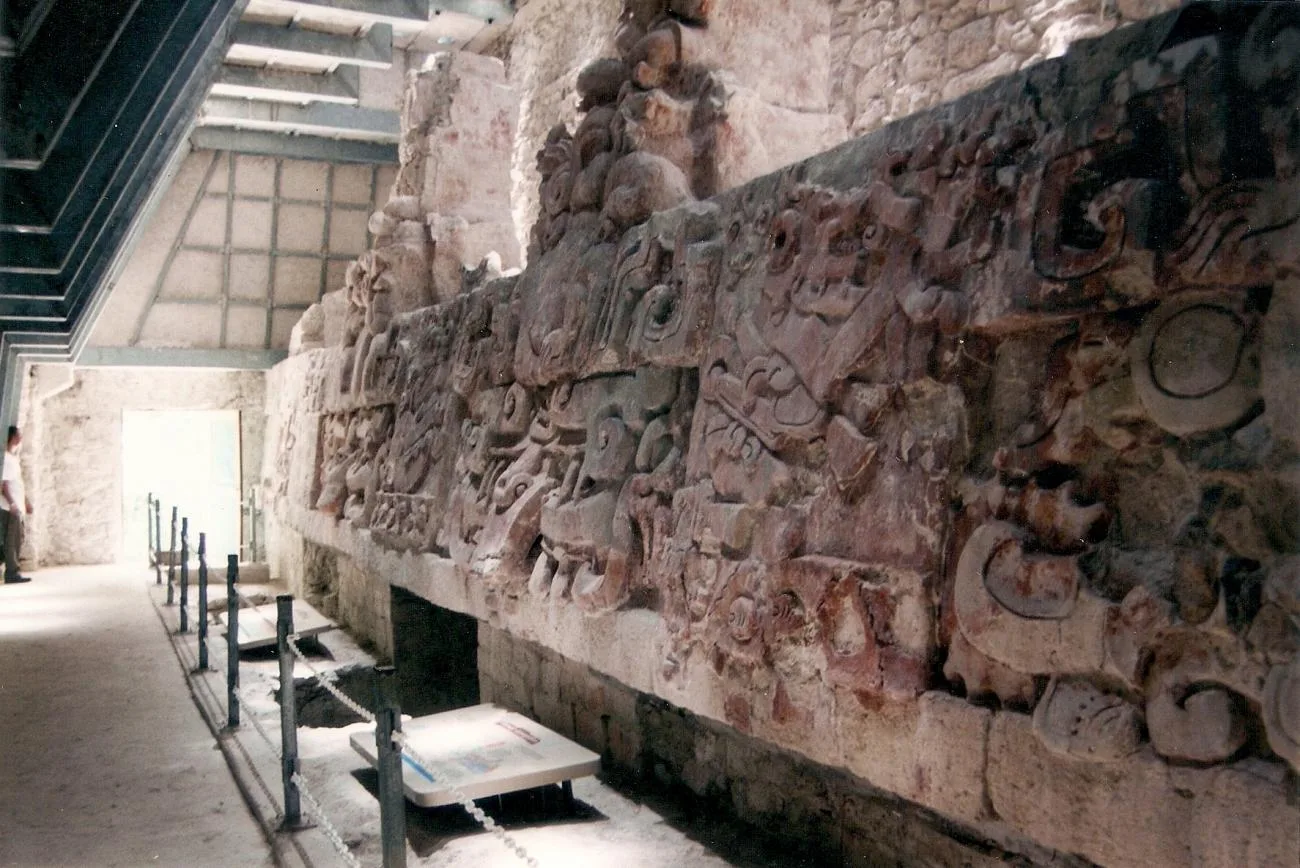
Balamkú's stucco frieze of earth-monsters and kings, one of the best-preserved in the Maya world.
Balamkú and the neighbours
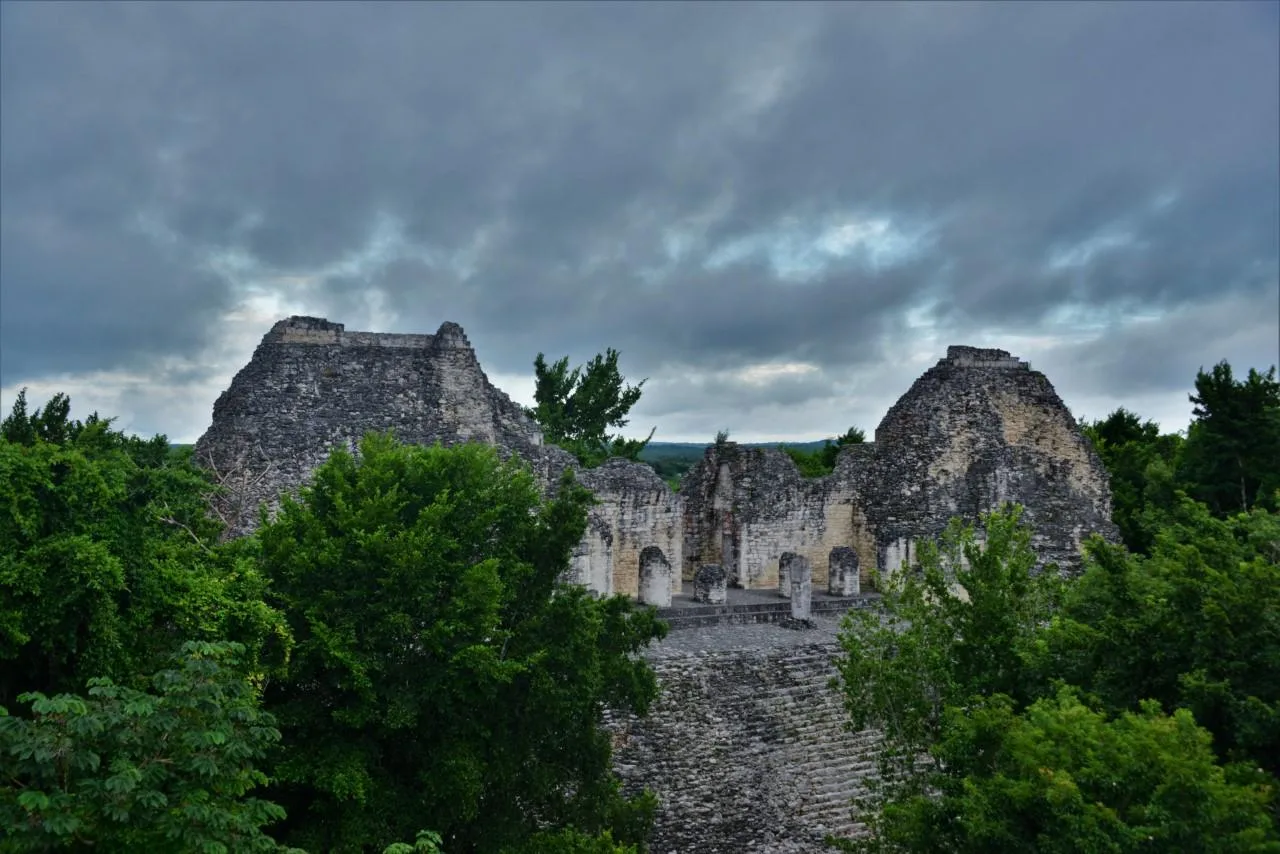
Most visits to Calakmul pair it with Balamkú, a smaller site on the approach famous for one extraordinary survival: a long modeled-stucco frieze, vivid with earth-monsters and royal figures, preserved in a sealed chamber in a state of completeness almost unheard of for such fragile work. The same southern corridor holds the great Río Bec cities, Becán, Chicanná and Xpujil, with their theatrical false towers and monster-mouth doorways. Travelers who give the region two days rather than one can string several of these together, sleeping at a jungle ecolodge between them.
How to visit Calakmul from Campeche
Calakmul rewards planning. It is far, about 365 km south of the walled city, five to six hours each way, and the site itself is vast, so the day is long by design.
| Distance | ~365 km south; 5-6 h each way, plus a 60 km road inside the reserve |
| Departure | Before dawn (around 5 a.m. is common) |
| Ideal length | A full day; two days to add Balamkú and the Río Bec sites |
| Best season | Dry (November to April), for road comfort and wildlife |
| Guide | Strongly recommended: inscriptions, murals and dynastic history are invisible without one |
Start before dawn: departures around 5 a.m. are standard, and the early hours bring the best wildlife, the kindest light, and the chance to reach the summit of Structure II before the heat. Consider two days rather than one, a night at a forest ecolodge near Xpujil or Chicanná lets you add Balamkú and the Río Bec cities without exhaustion. New rail access to the south, the Maya Train, has made the region meaningfully easier to reach than it was a few years ago; we trace the wider picture in Why Campeche is the perfect 2026 vacation. Go with a guide, the inscriptions, the murals and the dynastic history are invisible without one; our outdoor experiences and tailored itineraries arrange expert-led expeditions and the early starts they require. And travel in the dry season for the most comfortable conditions underfoot; see our guide to the best time to visit.
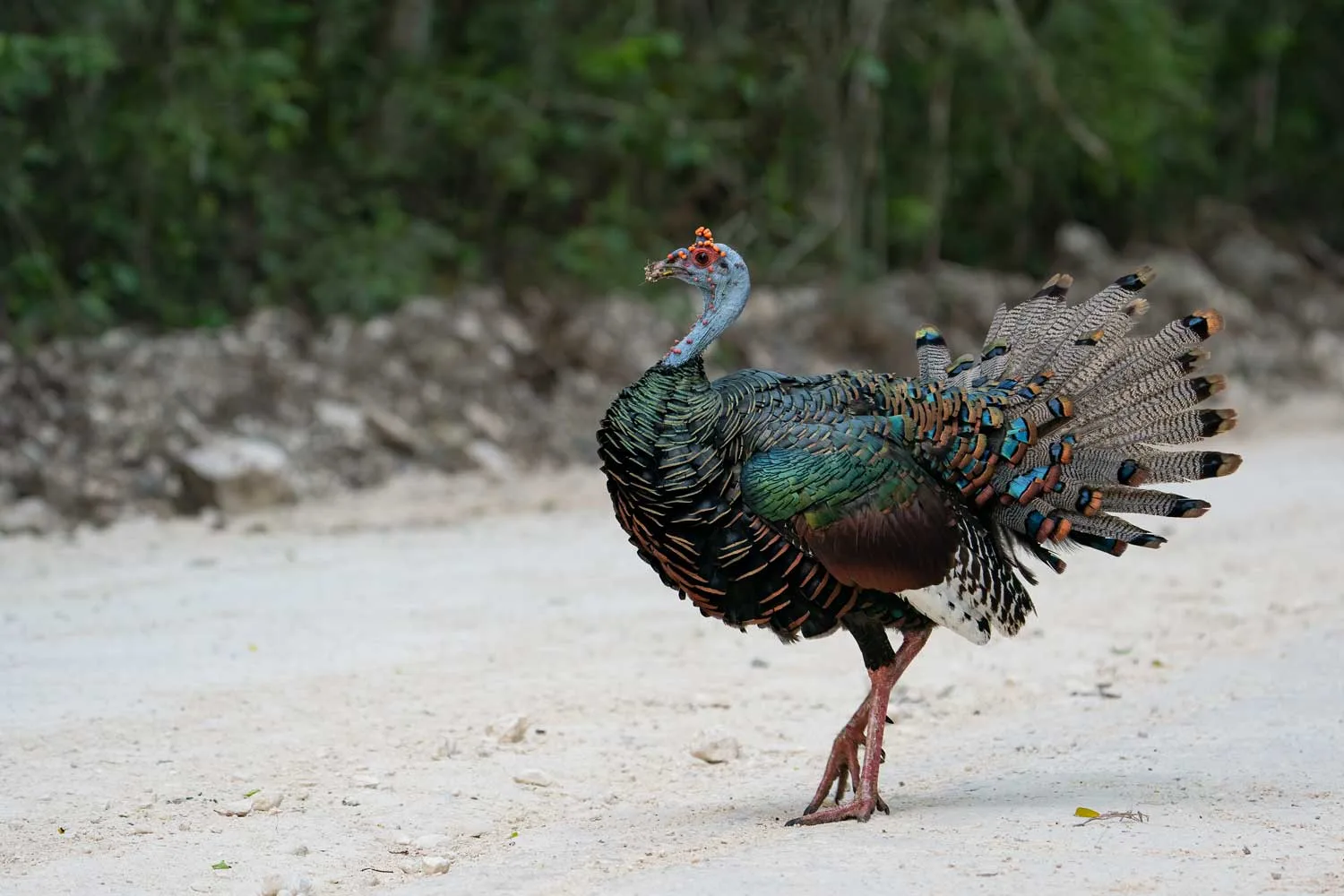
Dawn at Calakmul: the iridescent ocellated turkey, one of the reserve's signature birds.
You don't have to camp to do it well. The most civilized way to experience Calakmul is to make the walled city of Campeche your base, returning, after the jungle, to a cool courtyard and a proper bed inside a restored heritage home.
Planning your trip? Write to us on WhatsApp and we will send you Campeche in 72 Hours, our pocket guide, free of charge.
Receive the guide on WhatsApp →The mask that came home
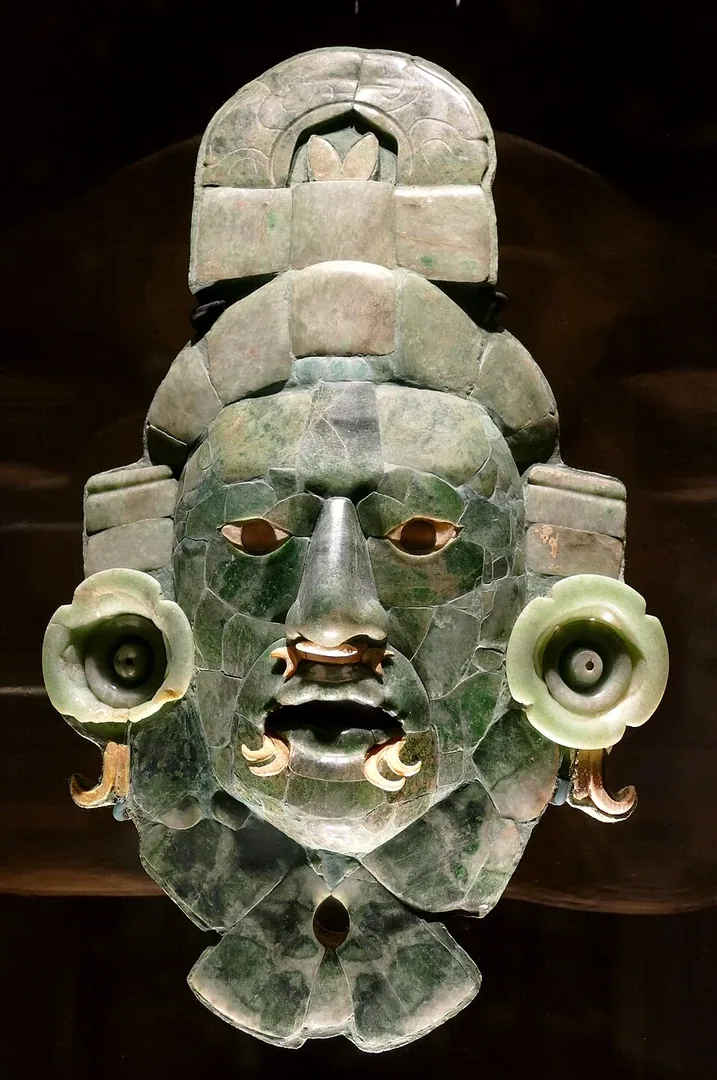
If you can't make the journey south, you can still meet a face from the Snake Kingdom. Among Calakmul's most celebrated finds is a funerary mask of jade mosaic, lifted from a royal tomb, and today it is displayed not in Mexico City but in Campeche itself, in the Museum of Maya Architecture, in the Baluarte de la Soledad, where it was moved in 2024. Standing before it, after standing on Structure II, closes a circle: the empire of the jungle and the colonial bastion that now guards its treasure, inside the walls, a short walk from your front door.
Frequently asked questions
What is Calakmul?
Calakmul is an ancient Maya city in the south of Campeche state, México, the capital of the Kaan (Snake) dynasty and one of the largest and most powerful cities of the Classic Maya world. It sits within the Calakmul Biosphere Reserve and is a Mixed UNESCO World Heritage site, recognized for both its archaeology and its tropical forest.
How do you visit Calakmul from Campeche?
It is a long day trip, usually a pre-dawn start and a multi-hour drive south, followed by a 60-km access road into the reserve. Many travelers prefer to split it over two days with a night at a jungle ecolodge. A guided trip is strongly recommended; the easiest base is the walled city of Campeche.
Is Calakmul better than Tikal or Chichén Itzá?
It is different. Calakmul rivals them in scale and history but receives a tiny fraction of the visitors, set in pristine forest, ideal for travelers who value solitude and depth over convenience.
What wildlife can you see at Calakmul?
The reserve is home to jaguar, puma, ocelot, tapir, spider and howler monkeys, ocellated turkey and hundreds of bird species. Early morning offers the best chances.
How long does a visit take?
Plan a full day for Calakmul alone. Two days lets you add Balamkú and the Río Bec sites (Becán, Chicanná, Xpujil) comfortably.
Reviewed and fact-checked in July 2026 by the Casonas MX editorial team in Campeche, with archaeological, conservation and access detail cross-checked against UNESCO (List 1061), INAH and the IUCN. We organize Calakmul expeditions from our houses inside the walled city.